
Orthodontics
ClearCorrect clear aligners in London, ON
Straighter teeth without brackets and wires. ClearCorrect uses a series of thin, clear, custom-made trays that gradually move your teeth — nearly invisibly.
Medically reviewed by Dr. Jimmy Chopra, DDS, General Dentist · RCDSO #503061 · Reviewed August 2026
How ClearCorrect works at Smilo
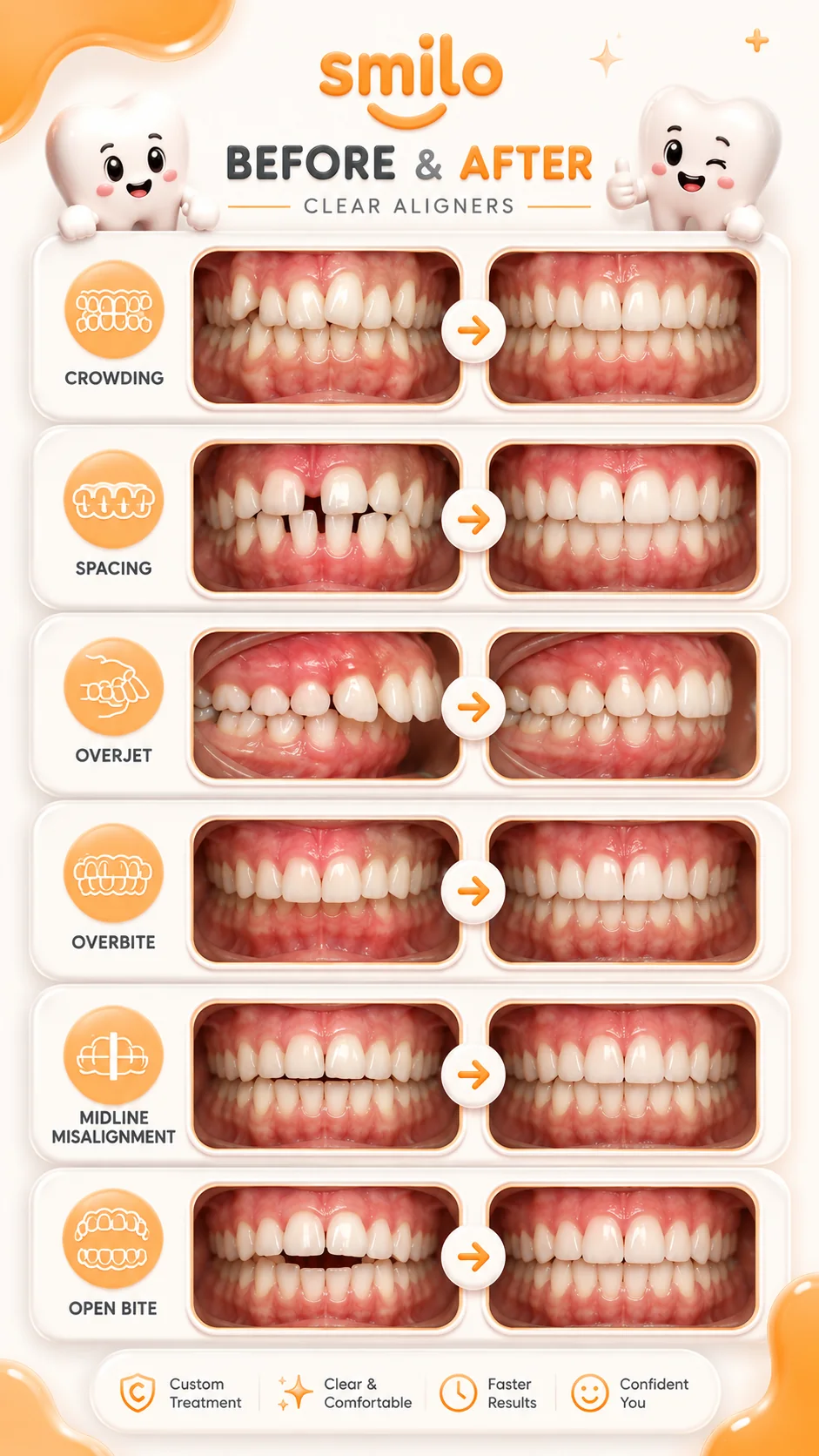
We start with a digital 3D scan — no goopy impressions — which maps your teeth precisely and becomes the blueprint for your custom treatment plan. ClearCorrect then makes a series of thin, clear trays, each one a small step closer to your finished smile. You wear each tray about 20–22 hours a day and switch to the next in the series every week or two as your teeth move, with quick progress visits along the way. When treatment ends, a retainer keeps your new smile in place.
Why patients choose clear aligners
- Discreet — most people won’t notice you’re wearing them.
- Removable — eat what you like and brush and floss normally.
- Comfortable — smooth, thin plastic; no brackets or wire adjustments.
- More than looks — correcting crowding and bite issues can make teeth easier to clean and protect long-term dental health.
What the trays ask of you
This is the part worth being straight about, because it is the difference between treatment that works and treatment that stalls. Aligners only move teeth while they are in your mouth.
- 20–22 hours a day, genuinely. That means they are in except for eating, drinking anything other than water, and cleaning your teeth. An hour here and there adds up quickly, and the usual result is not failure but delay.
- Take them out to eat. Chewing in them damages them, and anything other than water can stain them or get trapped against a tooth.
- Clean them, and your teeth, more often. Brushing after meals before the trays go back in matters more than it does without them.
- Expect the first few days of each new tray to feel tight. That pressure is the tooth moving. It settles within a day or two.
- Keep the old tray until the next one is comfortable — it is a useful fallback if one goes missing.
Some cases also need small tooth-coloured attachments bonded to a few teeth to give the trays something to grip. They come off at the end, and we will tell you at the planning stage whether yours needs them.
Is ClearCorrect right for you?
Clear aligners handle many cases of crowding, spacing and bite correction for both teens and adults — but not every case, and anyone who tells you otherwise is selling. Complex bite problems, teeth that need significant rotation, and some jaw discrepancies are still better treated with fixed braces, and occasionally the honest answer is a referral rather than a treatment plan.
Two things need to be sound before any aligner treatment starts: your gums, and any untreated decay. Moving teeth in an unhealthy mouth makes things worse, so a checkup comes first. An assessment tells us quickly, and you will get an honest answer either way.
Retainers — the part people skip
Teeth have a memory. Left to themselves after treatment they drift back toward where they started, and that is not a failure of the treatment, it is simply what teeth do. A retainer is what holds the result, and it is a permanent part of the deal rather than an optional extra at the end.
We will tell you what your retainer routine looks like before you commit to treatment, so it is factored into your decision rather than sprung on you at the finish.
Cost and insurance
Cost depends on how much movement is needed and how long treatment runs — a mild correction and a complex one are quite different cases. You will get the full cost in writing before you commit, including retainers, so there is nothing to discover later.
Some insurance plans include orthodontic coverage and some specifically exclude adults, so it is worth checking yours rather than assuming. We will help you look, we direct-bill where we can, and payment options can spread treatment over time.
Common questions
How long does treatment take?
It depends entirely on how far the teeth have to travel — a mild correction is a much shorter case than a complex one, and the honest answer needs a scan first. What we can tell you is that your plan will come with an expected number of trays and a timeline before you commit, rather than an open-ended arrangement.
Will anyone be able to tell I’m wearing them?
Most people will not notice. The trays are thin and clear, and they sit close to the teeth. If your case needs small attachments bonded to a few teeth to help the trays grip, those are tooth-coloured and come off at the end. They are more visible than the trays themselves, which is worth knowing in advance.
Will it affect how I speak?
Slightly, for the first few days. A mild lisp while your tongue adjusts to the trays is common and it passes quickly. Talking normally is the fastest way through it — most people stop noticing within a week.
What if I lose a tray?
Call us rather than simply skipping ahead to the next one. Depending on where you are in the series we may have you go back to the previous tray or move forward, and jumping ahead without advice can mean the next tray does not fit. This is also why it is worth keeping the previous tray until the current one feels comfortable.
Do I have to wear a retainer afterwards?
Yes, and we would rather you knew that before starting than after finishing. Teeth drift back toward their original positions if nothing holds them, so a retainer is what protects the result you have paid for. We will explain what your retainer routine involves as part of the treatment plan, not as an afterthought.
Related treatments
Aligners often sit alongside other work.
- whitening — many patients finish treatment with it.
- bonding or veneers — for shape and colour once teeth are straight.
- a checkup first — teeth and gums need to be healthy before aligners start.
Not sure which applies to you? Book a visit and we’ll talk it through, or read what to expect at a first visit.